Guiding Movement Through Branded Wayfinding
Environmental Design
Wayfinding Designer
Modeling
Photoshop
Sketchup
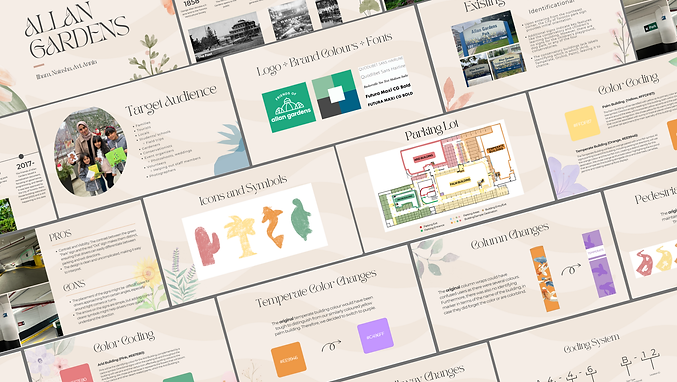
Teams were tasked with taking an existing brand and expanding it into the design of a conceptual parking garage. Our team selected Allen Gardens, a historic Toronto park and greenhouse, and set out to design a waydinging and signage system that would guide both vehicles and pedestrians while reflecting the park's identity. The challenge was to balance functional clarity with brand expression, ensuring circulation through the garage was not only efficient but also cohesive and welcoming.
Process
To ground the project in real-world context, the team began with an on-site evaluation of a parking garage in Toronto, analyzing what worked well in their wayfinding system and where gaps created confusion. These insights shaped our design principles, which emphasized clear circulation paths, intuitive placement of signage, and a visual hierarchy that supported both drivers and pedestrians.
Key steps included:
-
Mapping parking zones based on the building each user needed to reach.
-
Planning vehicle and pedestrian circulation paths throughout the garage.
-
Determining both the placement of signage and the content allocated to each side.
-
Categorizing signage into identification, directional, ortientational, and regulatory.
-
Developing a color-coded system with icons to differentiate buildings and guide users visually.
Our Solution
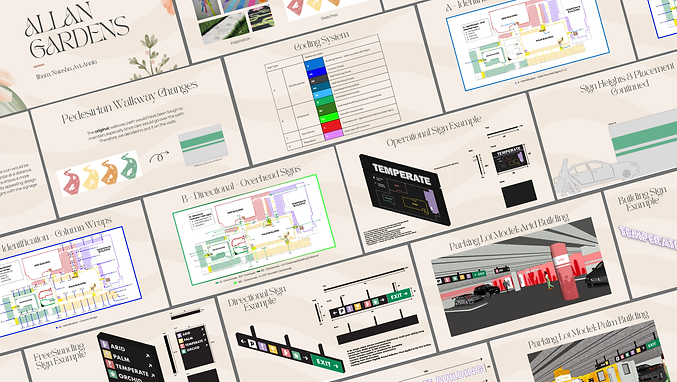
The team created a comprehensive wayfinding system that integrated signage, column prints, parking prints, and wall-mounted elements. Each layer of design reinforced clarity and cohesion while tying back to the identity of Allen Gardens through color and motif.
Signage elements included:
-
Column identification signs and parking prints for clear orientation.
-
Wall-mounted LED building names, murals, and painted stripes for strong visual identity.
-
Overhead directional signs for both cars and pedestrians.
-
Entrance and exit signs highlighting circulation flow.
-
Operational wall-mounted signs and regulatory signage like stop signs.
-
A coding sign schedule system to support accurate implementation.
Prototypes
Using SketchUp, the team condtructed a digital model that captured both the spatial layout and overall look and feel of the garage. Photoshop was then used to refine renderings with lighting and shadows, simulating realistic conditions such as illuminated LED building name signs. Illustrator was used to develop precise layouts, typography, and iconography for each sign. Together, these tools allowed us to move from conceptual mapping to polish, presentation-ready prototypes.
Impact
The final outcome was a fully integrated wayfinding and signage concept that demonstrated how branding can extend into functional infrastructure. By addressing both vehicle and pedestrian navigation, the system reinforced identity while improving clarity, circulation, and overall user experience. The project highlighted the value of strategic wayfinding - showing that even everyday elements like parking signage can contribute to storytelling, cohesion, and a stronger sense of place in public environments.
Contributing Creatives
This project was a collaborative effort shaped by the combined strengths, creativity, and problem-solving of our team. I had the opportunity to work alongside Ilham Farah, Annia Pavli, and Avilenne Lara as we expanded Allan Gardens’ identity into a fully developed wayfinding and signage system.
Ilham, Annia, and I carried the majority of the design development, working closely together on the mapping, signage families, circulation logic, 3D modeling, and rendering. We continuously shared progress, exchanged feedback, and aligned our decisions to ensure the final system felt cohesive and intentional.
The individual responsibilities:
-
I created the rendering for the Arid Building, featured at the top of this page, and developed the Operational Sign design.
-
Annia originated the concept for the Directional Sign family, and interestingly, she ended up modeling the Operational signs while I modeled the Directional ones - producing the top, side, front, back, and isometric views for presentation.
-
Ilham produced the Palm Building rendering and modeled the Free Standing sign.
-
Avilenne contributed by creating the icon set and murals.
The strength of the final outcome reflects the collaborative energy shared between Ilham, Annia, and myself, and our collective commitment to building a clear, cohesive, and brand-driven wayfinding system.